Quick answer: Commercial irrigation design starts with a site survey of soil, slope, water pressure, and plantings, then builds zoned layouts, backflow prevention, and smart controls around that data. In North Jersey’s clay soil and heavy seasonal rain, a well-planned system reduces runoff, water waste, and plant loss while meeting local code requirements for certified irrigation work.
Key takeaways
- A commercial irrigation design should start with a site survey covering soil type, slope, water pressure, and plant zones before any equipment is specified.
- Clay-heavy North Jersey soil drains slowly, so zoning and head spacing need to account for runoff risk rather than standard residential assumptions.
- New Jersey requires a business performing landscape irrigation work to hold the required business permit and employ a certified Landscape Irrigation Contractor; a home improvement contractor license is not a substitute.
- The EPA WaterSense program says efficiency measures and better irrigation practices could reduce a property’s outdoor water use by more than 50 percent.
- The design should address required backflow protection and, for newly installed automatic lawn sprinkler systems, the applicable rain-sensing device requirements from the outset.
What Makes Commercial Irrigation Design Different From Residential?
Commercial properties carry different stakes than a backyard lawn. A retail center, office park, or HOA common area typically has larger turf and planting areas, more hardscape, higher foot traffic, and a property manager or owner who answers to tenants, boards, or customers when something goes wrong. Water waste, soggy walkways, or dead plant beds at the entrance of a business reflect directly on the property’s image.
Design also has to account for scale. A commercial site irrigation plan usually involves multiple water sources, larger pipe diameters, more complex zoning, and coordination with parking lot drainage, loading areas, and sometimes athletic fields or courtyards. If you also need help with planning and layout for a home system, our residential sprinkler system design services cover that scope separately.
For the full range of installation, service, and lighting work tied to commercial properties, see our commercial irrigation, drainage and lighting services page. This article focuses specifically on how the design phase works.
How Does the Site Survey and Planning Process Work?
Every solid commercial irrigation design starts on-site, not on paper. Before anyone draws a zone layout, a few things need to be measured and documented.
Key inputs gathered during a site survey
- Static water pressure and flow rate at the point of connection, which determines how many heads or drip emitters each zone can support.
- Soil type and infiltration rate, especially important in North Jersey where clay-heavy soil absorbs water slowly and is prone to runoff on slopes.
- Grading and drainage patterns, including where water naturally pools after heavy spring and fall rain.
- Plant material and turf zones, since turf, shrub beds, and seasonal annuals all have different water needs and should be on separate zones.
- Hardscape and obstacles like sidewalks, parking islands, signage, and utility lines that affect pipe routing.
- Sun and shade exposure across the property, which changes evapotranspiration rates zone by zone.
An on-site review can reveal grading variations and soil compaction that satellite imagery and property plans may miss.
Why Does North Jersey’s Soil and Climate Matter for Commercial Design?
Bergen, Passaic, Morris, and Essex counties share a common challenge: dense clay subsoil combined with heavy spring and fall rainfall. Clay compacts easily under foot and vehicle traffic common on commercial properties, which slows infiltration even further. A system designed without this in mind tends to overwater the surface while the root zone stays dry, or it creates runoff that pools near building foundations and walkways.
Freeze-thaw cycles add another layer. Freeze-thaw cycles can heave saturated soil, while water left in irrigation components can freeze, expand, and cause damage; design should account for drainage and allow for proper seasonal servicing. Designing with these conditions in mind from the start, rather than retrofitting later, saves on repair costs and water waste over the system’s life.
Poor drainage on commercial sites often needs attention beyond irrigation. If standing water or foundation seepage is already a problem, our drainage solutions page covers French drains, catch basins, and grading corrections that frequently get designed alongside a new irrigation system.
What Are the Core Components of a Commercial Irrigation Design?
A commercial site irrigation plan typically includes several layers of planning, each building on the data from the site survey.
- Zoning by plant and turf type. Turf, shrub beds, trees, and annual color beds each get separate zones so watering volume and frequency match actual need.
- Head and emitter selection. Rotor heads, spray heads, and drip emitters are chosen based on area shape, wind exposure, and plant type rather than a one-size-fits-all approach.
- Pipe sizing and layout. Mainline and lateral pipes are sized to maintain adequate pressure across the longest run, which matters more on large commercial parcels than small residential lots.
- Backflow prevention. New Jersey’s Uniform Construction Code assigns inspection responsibility for an irrigation system’s backflow preventer to the plumbing subcode, so the design should identify the applicable backflow protection and inspection requirements.
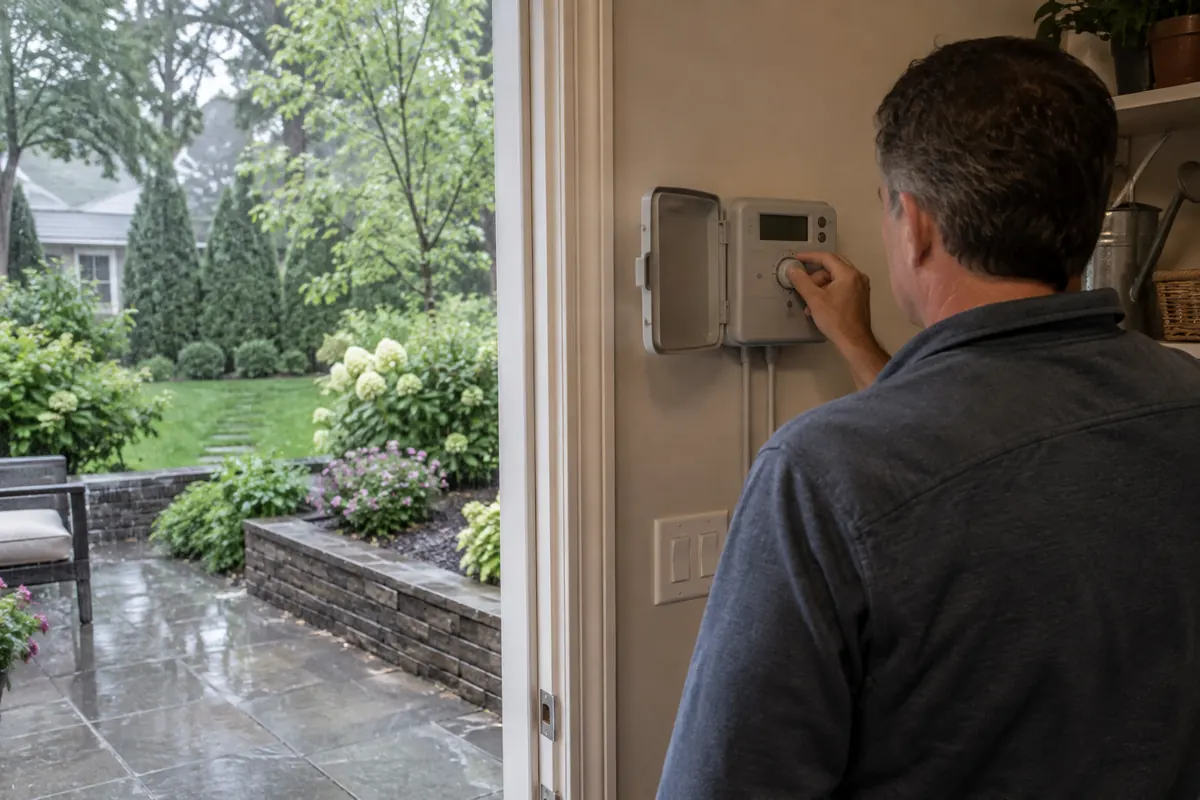
- Rain sensors and smart controllers. State rules require automatic rain-sensing devices on newly installed automatic lawn sprinkler systems, and a weather-based or WiFi controller can layer in further savings.
- Water source and point of connection review. Municipal supply, well, or irrigation meter all affect flow rate, cost structure, and design constraints.
Controller technology has advanced quickly in recent years. If your current system has aging equipment, it may be worth reviewing options through a controller retrofit alongside any redesign work.
How Can Commercial Properties Reduce Water Use Without Hurting Landscape Health?
Water management for businesses is not just a cost issue, it is increasingly a compliance and sustainability consideration for property owners and tenants. According to the EPA’s WaterSense at Work program, implementing irrigation efficiency measures and practices could reduce a property’s outdoor water use by more than 50 percent. Uneven water application can contribute to that waste because some areas may be overwatered to keep the driest spot green.
Practical water-saving strategies for commercial sites
- Group plants and turf with similar water needs onto the same zone (hydrozoning) instead of mixing turf and drought-tolerant shrubs on one valve.
- Use head-to-head coverage spacing so water reaches evenly between sprinklers instead of leaving dry gaps or soggy overlap.
- Install drip irrigation for planting beds and foundation landscaping, which applies water directly to the root zone with far less evaporation loss than spray heads; see our dedicated page on irrigation and sprinkler system services for how drip and spray zones work together.
- Adjust seasonal run times rather than irrigating at the same rate year-round, since landscape water needs change dramatically between July heat and a cool, rainy October in North Jersey.
- Pair the system with a smart or WaterSense-labeled controller that adjusts for recent rainfall and evapotranspiration data automatically.
Overwatering is not a minor inefficiency. The EPA notes that excess water can damage plants more than underwatering and often ends up as runoff that carries pollutants into storm drains and nearby waterways.
What Does New Jersey Require for Commercial Irrigation Work?
New Jersey regulates irrigation contracting separately from general home improvement licensing. Under the Landscape Irrigation Contractors Examining Board rules (N.J.A.C. 7:62) and related state statute, a business performing irrigation construction, repair, or alteration work must hold a business permit and employ a certified Landscape Irrigation Contractor. The New Jersey Department of Community Affairs is explicit that a home improvement contractor license does not substitute for this certification.
On the construction side, the state’s Uniform Construction Code assigns code-official inspection responsibility specifically to the backflow preventer and, where applicable, the rain-sensing device on newly installed systems. Property managers planning a commercial design should confirm their contractor’s certification status and make sure applicable backflow protection and rain-sensing requirements are addressed in the plan from day one, not treated as an afterthought during final inspection.
For general background on how system design, installation, and seasonal service fit together, our complete irrigation and sprinkler guide walks through the full lifecycle of a system.
What Should a Commercial Irrigation Design Proposal Include?
When comparing design proposals for a retail property, office complex, or HOA common area, a few elements separate a thorough plan from a rushed one.
| Design Element | Why It Matters |
|---|---|
| Site survey notes (soil, slope, pressure) | Confirms the plan is based on actual site conditions, not assumptions |
| Zone map by plant and turf type | Prevents overwatering drought-tolerant plantings or underwatering turf |
| Backflow preventer and rain sensor placement | The plan should address required backflow protection and rain-sensing requirements for newly installed automatic lawn sprinkler systems |
| Pipe sizing and pressure calculations | Ensures even coverage across large or irregularly shaped commercial lots |
| Controller type and scheduling approach | Determines how much water-saving potential the system can capture over time |
| Drainage coordination notes | Flags areas where grading or a French drain may be needed alongside irrigation |
A proposal missing a site survey or zone map is a sign the design was templated rather than built for the property. You can browse examples of completed commercial and residential layouts in our project gallery.
How Does Design Connect to Long-Term Maintenance and Lighting?
A well-designed system still needs seasonal attention to perform as intended. Spring startups, fall winterization, and routine inspections catch pressure drops, head misalignment, and controller drift before they turn into water waste or landscape damage. Our irrigation and lighting maintenance services page covers how ongoing service plans keep a newly designed system running efficiently for years.
Many commercial properties also plan landscape lighting at the same time as irrigation, since both involve trenching, zoning, and coordination with plant beds. Addressing them together during design can reduce disruption to the property later. Elite Irrigation & Drainage designs and installs custom landscape lighting alongside irrigation work for properties that want both handled in one project.
If drainage issues surface during the site survey, such as low spots that collect water after storms, it is worth resolving those before finalizing zone layouts. Our complete drainage solutions guide explains how grading, catch basins, and piping integrate with an irrigation plan.
Frequently Asked Questions
How long does commercial irrigation design typically take before installation starts?
Timelines vary by property size and complexity, but a thorough design phase for a commercial site generally takes longer than a residential yard because of the additional site survey work, zoning detail, and permitting coordination. Properties with existing drainage problems or complex plantings may need extra time for grading and plant-zone planning before installation begins.
Does a commercial property need a different controller than a residential system?
Commercial sites typically need controllers with more zones, stronger weather-based scheduling features, and sometimes remote access for property managers overseeing multiple locations. A WaterSense-labeled or smart controller can adjust watering automatically based on rainfall and evapotranspiration, which matters more on larger commercial landscapes with mixed plant types.
Who is responsible for backflow preventer inspections on a commercial system?
Under New Jersey’s Uniform Construction Code, the backflow preventer and, where applicable, the rain-sensing device fall under the plumbing subcode’s inspection responsibility, separate from the irrigation contractor’s certification requirements. Property managers should confirm both the installation and the required inspection are scheduled during the project.
Can an existing commercial irrigation system be redesigned without full replacement?
Yes, in many cases zones, heads, or controllers can be upgraded or reconfigured without replacing the entire mainline or pipe network, especially if the original layout is in reasonably good condition. A site assessment is the best way to determine whether a partial redesign or a full system replacement makes more sense for the property’s age and condition.
What is the difference between a site irrigation plan and a planting plan?
A site irrigation plan focuses on water delivery: zones, pipe routing, pressure, and controller scheduling. A planting plan, usually created by a landscape architect, determines what gets planted where. The two should be coordinated, since plant water needs directly drive how the irrigation zones are grouped and scheduled.
Sources
- WaterSense at Work Section 5.2: Irrigation (U.S. EPA)
- Irrigation with a Pro (U.S. EPA WaterSense)
- N.J.A.C. 7:62 Landscape Irrigation Contractors Rule (NJDEP)
- Landscape Irrigation Contractor Licensing (New Jersey Department of Community Affairs)
- Construction Code Communicator, Spring 2025 (New Jersey DCA)
Ready to Get Started?
If you are considering a new sprinkler system, need help with a drainage problem, or want to brighten your property with landscape lighting, the team at Elite Irrigation & Drainage is ready to help. Call us at 862-899-7122 or visit our contact page to request a free estimate.
Written by the team at Elite Irrigation & Drainage, a North Jersey irrigation, drainage and landscape lighting company in Saddle Brook serving Bergen, Passaic, Morris and Essex counties.